Campervan electrics explained: leisure batteries, split charge, solar and hook-up
The part of a conversion you cannot see once the panels are back on, and the one place a cheap build gives itself away. What each component does, in plain English.
Co-founder of HubDub Campers. Writes most of what you read here. Spends the rest of his time in the Petersfield workshop.
More about HubDubElectrics are where conversions differ most and where buyers can compare least, because all of it disappears behind carpet before you ever see the van. Two conversions photographed side by side can be five hundred pounds apart or five thousand, and the photographs will not tell you which.
So this is the plain-English version: what each part does, what we fit as standard, and the three questions that separate a sound electrical installation from one that will annoy you within a year.
The four jobs an electrical system does
Store energy. Put energy in. Get energy out at the voltage your appliances want. And tell you what is going on. Every campervan electrical system, from the cheapest to the most elaborate, is those four jobs.
The leisure battery
A second battery, entirely separate from the one that starts the engine. This is the point of the whole exercise: your fridge, lights and water pump run off the leisure battery, so you can park up for a night and still start the van in the morning.
Every HubDub conversion carries a 110Ah leisure battery as standard. In practice that runs the Dometic compressor fridge, the LED lighting, the water pump and phone charging comfortably overnight and through a weekend, which is what the overwhelming majority of owners actually do with their van.
Bigger banks exist and lithium is genuinely excellent, and if you intend to work from the van for a fortnight off-grid we will happily specify accordingly. But be honest about the use case before you buy capacity. A large bank you never discharge is money parked under a seat, and it is heavier than the brochure implies.
Charging from the engine, and the thing to ask about
If there is one section of this article to read, it is this one, because it is the most common expensive shortcut in the industry.
Traditionally a leisure battery is charged while you drive through a split-charge relay: a switch that connects the leisure battery to the alternator when the engine runs and disconnects it when it stops. Simple, cheap, and it worked perfectly well for thirty years.
Then Euro 6 arrived. A modern van has a smart alternator, which varies its output to save fuel and drops its voltage as soon as the starter battery is full — often within a few minutes of setting off. Behind a simple relay, your leisure battery sees that low voltage and never reaches a full charge. You drive for four hours and arrive with a battery that is emptier than you think.
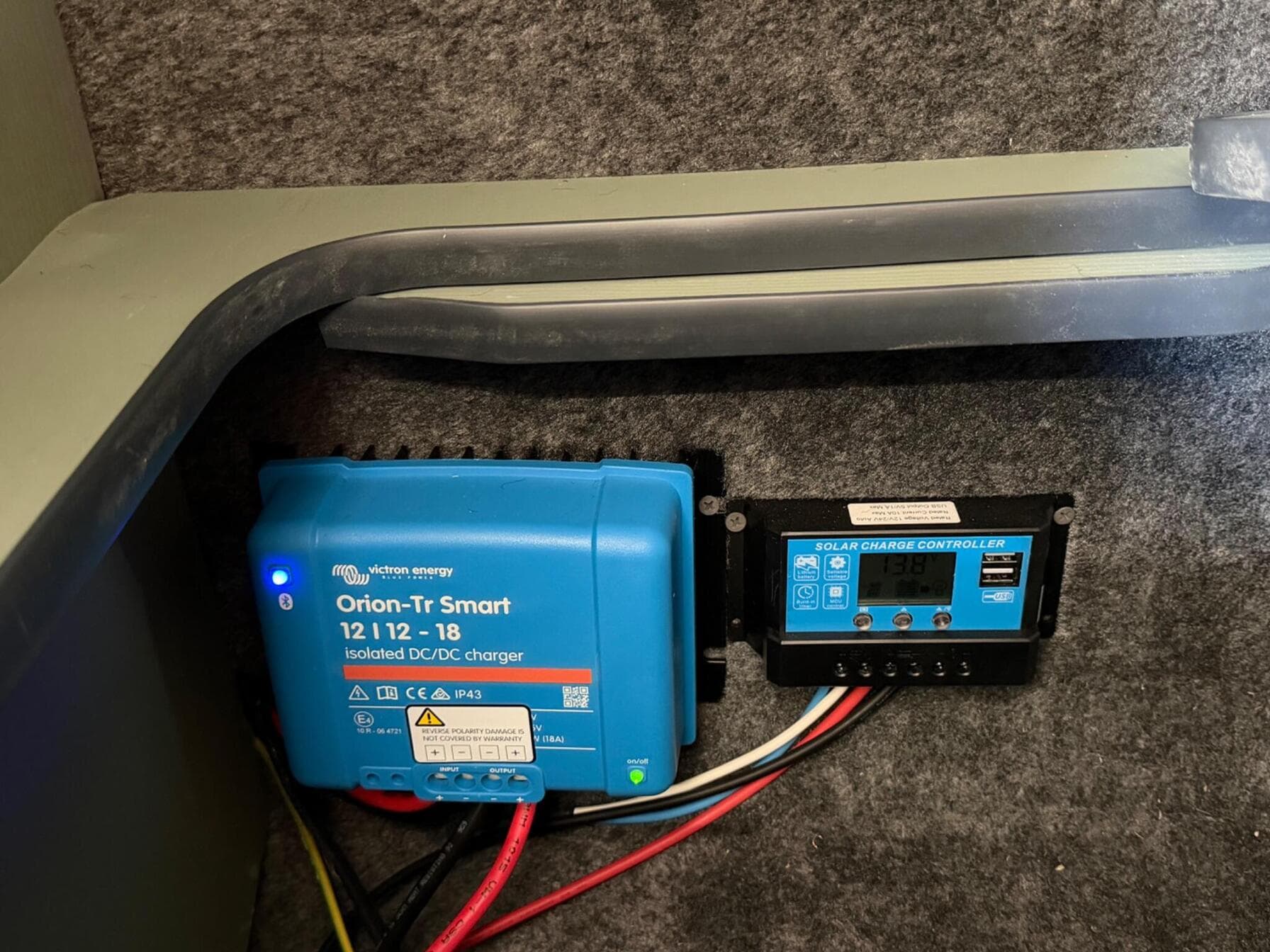
The fix is a DC-to-DC charger, which takes whatever the alternator gives it and delivers a proper, controlled charging profile regardless. We fit a Victron Orion-Tr Smart. It costs meaningfully more than a relay, it lives under a seat where nobody will ever see it, and it is the single clearest test of whether a converter is building for the photograph or for the fifth year.
So: ask any converter whether the van charges through a split-charge relay or a DC-to-DC charger, and ask why. The answer tells you a great deal about everything else you cannot see.
Solar
A roof panel and a charge controller, topping the leisure battery up whenever there is daylight. Our standard fit is a 100W panel with its own controller.
What 100W realistically does in Britain: through the summer it comfortably offsets a fridge running full time, which is the difference between coming back to a healthy battery after a week parked up and coming back to a flat one. Through December it does very little, and anyone who tells you otherwise has not measured it. Solar's real value is not powering your van, it is stopping it going flat while you are not using it.
Mains hook-up and 240V
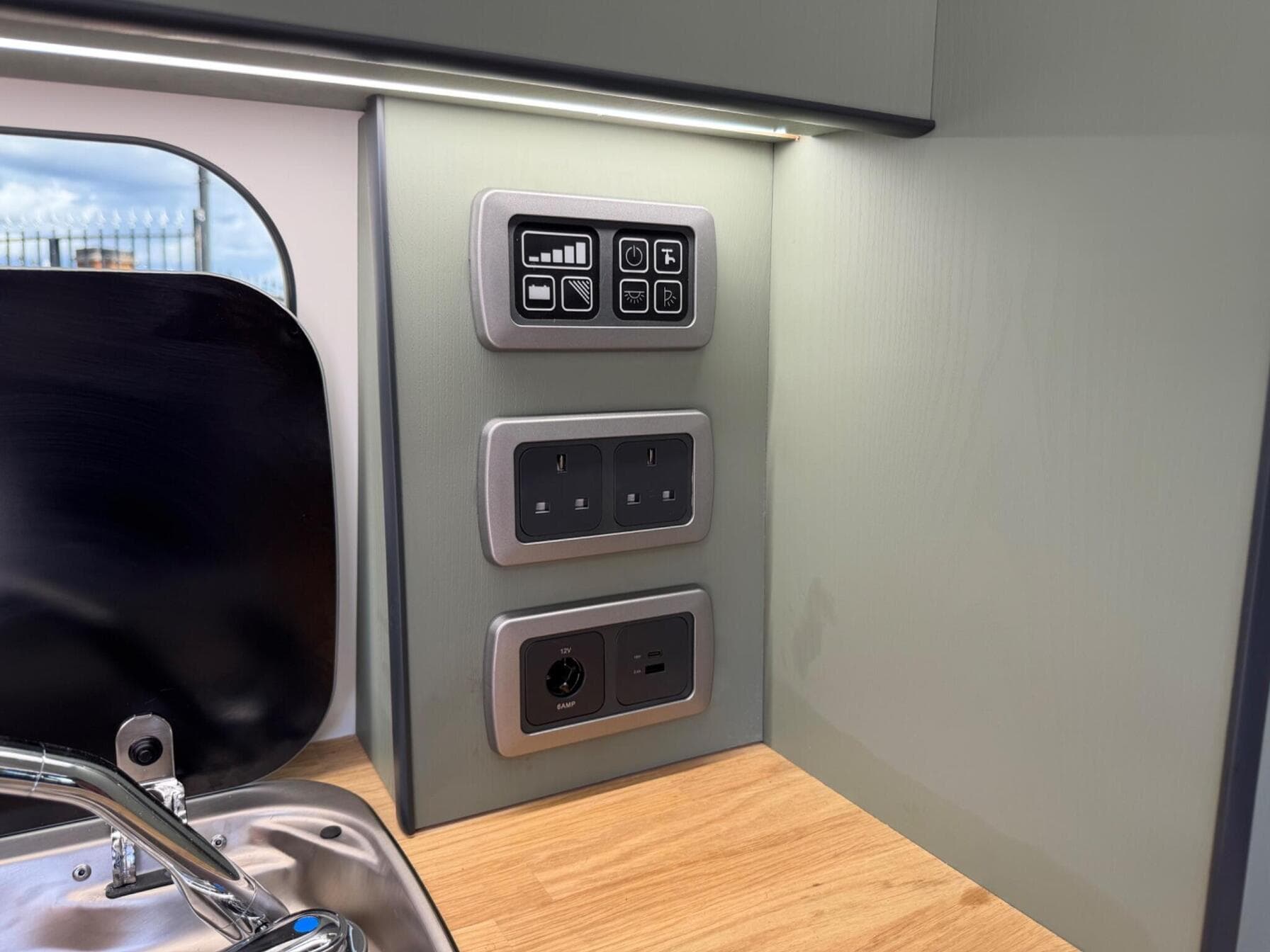
Plug into a campsite bollard and two things happen: a charger replenishes the leisure battery, and your three-pin sockets go live. Ours runs through a double-pole consumer unit with RCD protection, a double 13A socket, a 15A automatic battery charger and an external input point.
Here is the second question worth asking a converter. Our three-pin sockets are live on hook-up only, deliberately. A conversion that quietly runs its mains sockets off an inverter feels more generous on the forecourt and is how people flatten a leisure battery on the first night, usually with a hairdryer or a kettle they had no reason to think was a problem. If sockets work off hook-up, that should be a decision somebody explained to you, not a surprise.
Inverters
An inverter converts 12V from the leisure battery into 240V for household appliances. Whether you need one is a question about what you intend to plug in, and the honest answer for most buyers is that they need less than they think.
- Phones, laptops and camera batteries: no inverter needed. USB and 12V outlets do this more efficiently, and every HubDub conversion has both.
- A kettle or a toaster: technically possible on a large inverter, but a kettle draws a colossal amount for the few minutes it runs. Gas boils water faster and cheaper, which is why the hob is where it is.
- A hairdryer or a coffee machine: this is what people actually want an inverter for, and it is worth being deliberate about it. Specify the inverter around the appliance, and size the battery around the inverter, in that order.
The mistake is buying a large inverter and a small battery. The inverter is not the constraint; the energy behind it is.
Lighting and outlets
Four LED touch-sensitive downlighters in stainless-effect housings, a 12V socket and a USB point, all on the leisure battery. LED draw is small enough that lighting is effectively free — you could leave every light on all night and not trouble the battery, which is emphatically not true of anything with a heating element in it.
Where it all goes
One panel at eye level, with the battery and solar readout, the sockets, the 12V outlet and USB-A and USB-C together. Not a switch by the door, a fuse box under the bed and a battery monitor behind the wardrobe.
This sounds like a detail and it is not. The readout is how you learn your own van — what a fridge actually costs you overnight, what the battery looks like after two days of rain. Owners who can see that information use their vans with confidence. Owners who cannot end up plugging in unnecessarily, or worse, learning the hard way.
The three questions
- Does it charge through a split-charge relay or a DC-to-DC charger, and why? On a Euro 6 van there is only one right answer.
- Are the three-pin sockets live off hook-up? If yes, what stops them flattening the leisure battery?
- Where is the battery monitor, and can I read it without opening a cupboard?
Common questions
On any Euro 6 van — which is every VW Transporter and Ford Transit Custom worth converting — you need a DC-to-DC charger. A smart alternator drops its voltage once the starter battery is full, so a simple split-charge relay never gets the leisure battery to a full charge no matter how far you drive. A DC-to-DC charger delivers a proper charging profile regardless of what the alternator is doing.
A 110Ah leisure battery, which is HubDub's standard fit, comfortably runs a compressor fridge, LED lighting, a water pump and phone charging through a weekend — which covers how most owners actually use their van. Larger banks make sense for extended off-grid stays or if you work from the van, but capacity you never discharge is money and weight parked under a seat.
A 100W panel is HubDub's standard fit and does the job most owners need: through summer it offsets a fridge running full time, so the van does not go flat while it sits between trips. In midwinter British light, solar of any size contributes very little. Its real value is maintenance rather than power generation.
Only through an inverter, and only with the battery capacity to back it. Anything with a heating element draws heavily, so gas boils water far more efficiently than an inverter and a kettle. If you want a hairdryer or a coffee machine, specify the inverter around that appliance and then size the battery around the inverter — in that order.
Not by default. HubDub three-pin sockets are live on mains hook-up only, deliberately. A conversion that quietly runs its sockets off an inverter looks more generous on the forecourt and is the usual way people flatten a leisure battery on the first night.